Why is it so hard to do the things we know are good for us?
Why is it that we know so many things that are good for us, yet somehow, we continue to find ourselves unable to commit to these habits consistently?
Most of us know that supporting our health looks like:
Cooking our own meals.
Sleeping eight hours.
Getting fresh air.
Exercising, stretching
Spending less time on our phones.
Socializing with people we love
Having hobbies
Most of us already know what would help us feel better.
And yet, it’s tempting to believe that we have a discipline or motivation problem.
But in my experience, that’s rarely the real problem.
We might say things like:
“I don’t have enough time.”
“I don’t have enough energy.”
“I’m not even sure where to start.”
These are the thoughts that keep us cycling in circles, convincing us that we need to wait for the right moment—or read another book, buy another supplement, or finally receive the diagnosis that explains everything.
But what if the problem isn’t a lack of information?
But that we’ve become disconnected from the very rhythms that create time, energy, and clarity in the first place.
When we ignore our body’s needs over and over life begins to feel like an uphill battle.
Not because we’re failing. Because we’re asking a depleted system to keep giving us more.
We often place so much expectation on the one healthy thing we do that we expect it to undo the many ways we’re simultaneously taxing our bodies, and quickly.
And so these very habits that would restore our energy, with enough consistency and time, begin to feel impossible or, worse, ineffective.
Our disconnection from these natural rhythms makes those rhythms increasingly difficult to return to. And so the cycle continues.
One of the reasons I fell in love with Chinese Medicine…
Chinese Medicine didn’t teach me that healing began with finding the right treatment.
It taught me that healing begins by creating the conditions in which the body can heal.
One way I like to explain this is through what I call the Eight Pillars of Health.
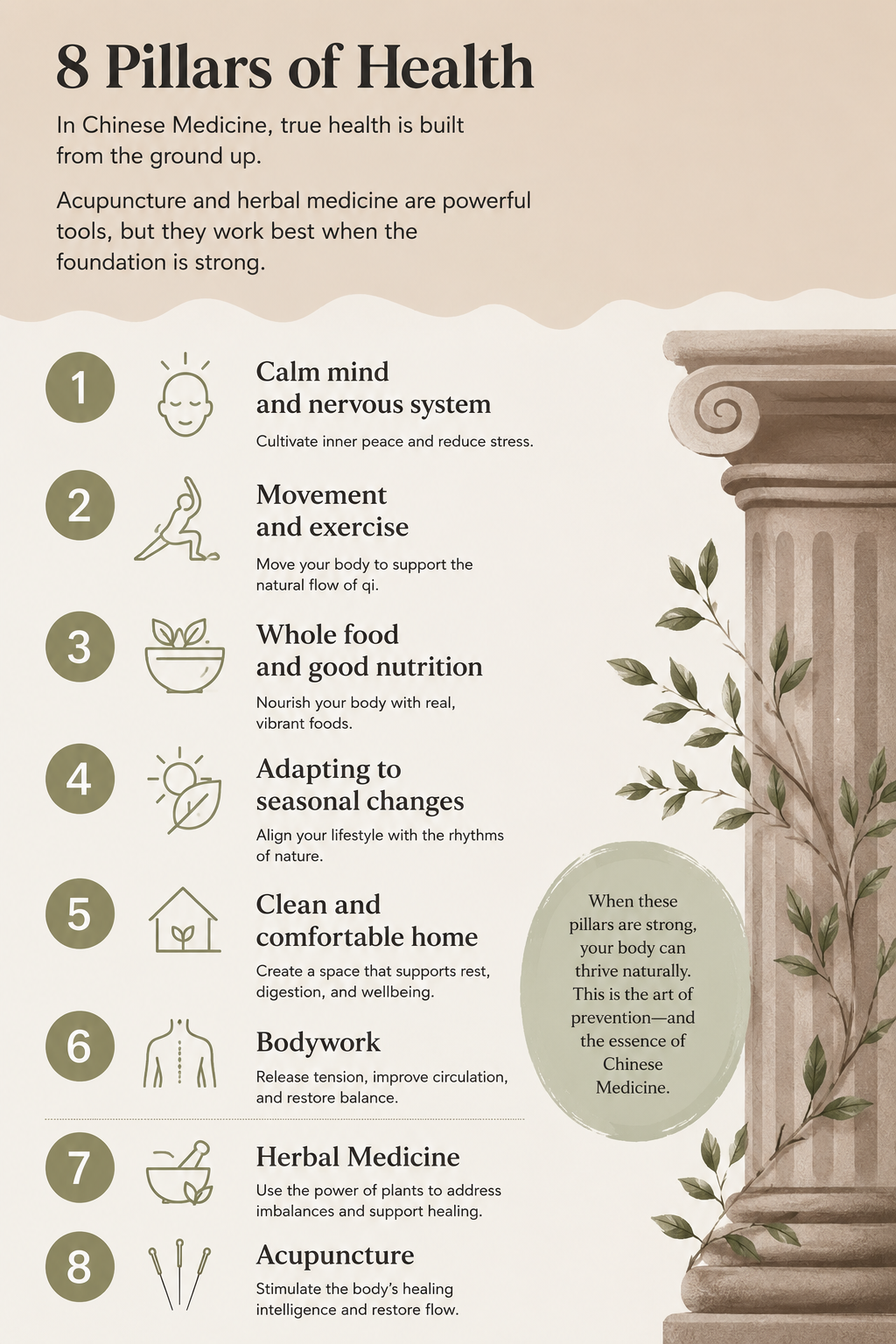
Inspired by the idea of the 8 Branches of TCM.
The first six pillars are self-supportive practices that create the foundation for health:
Calm mind and nervous system
Movement and exercise
Whole food and good nutrition
Adapting to seasonal changes
A clean and comfortable home
Bodywork
The final two pillars are therapeutic interventions (even bodywork could be considered a therapeutic intervention):
Herbal Medicine
Acupuncture
As an acupuncturist, that may sound like a surprising thing to say.
But I’ve never believed acupuncture is magic. I’ve always believed the body is.
Acupuncture and herbal medicine are incredibly powerful tools, but they work best when they’re supporting a body that is also being nourished through everyday life.
When the foundation is weak, treatment often feels like taking two steps forward and one step back.
When the foundation becomes stronger, healing begins to build momentum.
What made the biggest difference for me wasn’t discovering another health tip or another supplement.
It was developing trust in Chinese Medicine.
The more I understood its connection to the natural world, the more I began to realize that I wasn’t separate from nature—I was part of it.
My body wasn’t working against me.
It was responding to the way I was living.
Once I began living in greater harmony with those natural rhythms, many of the habits that had once felt impossible gradually became… normal.
Not overnight.
But little by little.
Trust.
